
 Your Account
 Email Sign-Up
 Buy Annual Pass

Habitats of southeast Michigan: Southern Michigan forests
5.13.2026
Abby Lauer, Park Interpreter
If you need to clear your mind, might I suggest a walk in the woods? We are very lucky to live in a state with a wide variety of woodland options. Michigan may be known as the Great Lakes state, but we also have notable forest communities. Forests make up over half of our state in Michigan. Forests benefit us by providing homes for many types of wildlife and plants, a filter for our air and water resources, and a place for people to recreate and enjoy.
When you walk into a forest, you may be curious about the types of trees that surround you. There are two types of trees, deciduous trees and coniferous trees. Deciduous trees or hardwoods have broad leaves. They produce nuts or fruit and go dormant in the winter. Conifers or softwoods are trees that have needles rather than leaves. An example of a conifer is the Michigan State tree, the Eastern White Pine. A notable deciduous tree found throughout southern Michigan is the white oak tree.
To identify a forest community, you can look for what soils are present, the overall landscape, the animals and plants that inhabit the area, and how close it is to water sources. According to Michigan Natural Features Inventory, there are seven main forest communities in this part of Michigan (Forest Groups). Classifying a forest depends on the types of trees that are present and the tree cover of the area. To identify the forest community while hiking, you can see if there are any unique features surrounding the habitat, like open areas, soils, associated plants, and signature trees. The most common forest types in southeastern Michigan are oak-hickory dry-mesic southern forests, beech-maple mesic southern forests, floodplain forests, and southern hardwood swamps.
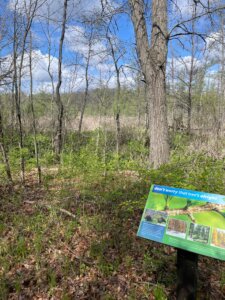
Over time there have been many changes to forest habitats in Michigan. The forests that we see today have been heavily influenced by humans. One of the biggest current threats to southern Michigan forests is non-native species that outcompete with native plants and take resources away from the habitat structure. You may have heard of some of the most common non-native species like garlic mustard, buckthorn, autumn-olive, and oriental Bittersweet. You can help by joining the Metroparks Natural Resources crew to help fight invasive species, plant trees, or gather native seeds by signing up for one of the upcoming volunteer workdays. More information about the workdays is here: volunteer workdays.
Vegetation Surveys in the Metroparks
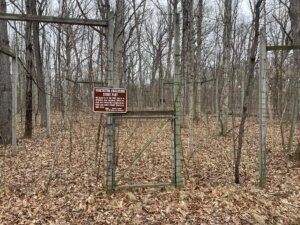
Have you ever come across a gated area with a sign that reads “Metroparks Vegetation Study Plot”? We are conducting a long-term study in all our parks on the native plants in our forest habitats. Vegetation plots are a technique used to evaluate health and the long-term impacts of deer use in each park. Plants inside the deer-proof fence are compared to an unfenced area outside the plot. Staff collect data on leaf cover, plant species inside and outside the vegetation plot, and other general observations. The data that is collected provides insight into the forest community, the diversity of plant species, and impact that wildlife has on park habitats.
Wildlife that depends on forests
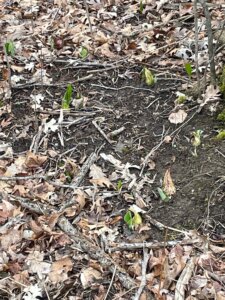
Early spring is a great time to take a walk through the woods. Before the trees leaf out, wildflowers are found along the forest floor. These flowers, often called spring ephemerals, are the first plants to flower in spring. They have a short life cycle and will be back to dormancy by late summer. The most common spring ephemerals in Michigan are bloodroot, trout lilies, spring beauty, trillium, Dutchman’s breeches, and hepatica.
As you hike, observe the understory of the forest. Here you can see smaller trees, shrubs, and vines. Common native plants you can find on trails are witch hazel, blueberries, flowering dogwood, wild geranium, Sassafras, Mayapple, poison ivy, and Virginia creeper. Test your animal track knowledge and see if you can find animal signs along the trail. Mammals that are common in this habitat are gray squirrels, eastern chipmunks, white-tailed deer, mice, and beavers.
Bring out your binoculars and observe native birds that call southern Michigan forests their home. Practice listening to bird calls and check each Metropark to see if they have a bird list to check off during your visit. Some notable birds that are found in forests are the red-headed woodpecker, pileated woodpecker, ruby-throated hummingbird, cedar waxwing, Carolina wren, and downy woodpecker.
Where to find forests in the Metroparks?
After you check out the Kensington Nature Center, head to the Deer Run nature trail to experience a southern dry mesic deciduous oak mixed hardwood forest.
This summer, cool off at Hudson Mills Metropark. Explore the woods that surround the Huron River as you hike the Acorn Nature Trail.
Check out Indian Springs Metropark nature trail to see a southern mesic deciduous maple-beech forest. Hike along the paved trail directly behind the park office.
To enjoy a woodland area, head to Lake Erie Metropark. Park at the park office and proceed north on the hike bike path.
If you live near Oakwoods Metropark, stop by this summer to enjoy the Big Tree trail and see an example of a southern dry-mesic deciduous oak mixed hardwood forest.
Explore Stony Creek Metropark Nature Center after checking out the Lakehead Trail and see an example of a southern mesic deciduous maple-beech forest.
Resources:
Cohen, J.G., M.A. Kost, B.S. Slaughter, D.A. Albert, J.M. Lincoln, A.P. Kortenhoven, C.M. Wilton, H.D. Enander, and K.M. Korroch. 2020. Michigan Natural Community Classification [web application]. Michigan Natural Features Inventory, Michigan State University Extension, Lansing, Michigan. Available https://mnfi.anr.msu.edu/communities/classification.
Dickmann, D. (2004). Michigan forest communities: a field guide and reference. Michigan State University Extension.
Dickmann, D. I., & Leefers, L. A. (2016). The forests of Michigan. University of Michigan Press.
 YOUR ACCOUNT