
 Your Account
 Email Sign-Up
 Buy Annual Pass

Sounds of Spring in Your Metroparks
4.15.2026
By Erin Parker, Interpretive Services Supervisor
Spring arrives in fits and starts, but one clear sign that the season has changed, regardless of the temperature, is the soundscape of any outdoor adventure! From frogs and toads to the songs of birds, wildlife tells us that spring is here.
Frogs and toad chorus
The first rainy night of the season, usually in March, triggers the start of Michigan’s frog breeding season. And breeding season means noisy songs coming from every pond, drainage ditch, and wet woodland! Frogs, toads, and their quiet cousins, the salamanders, have to take advantage of early spring’s rain and snowmelt to breed. And male frogs and toads work to find their mates by singing loudly!
The earliest singers are associated with vernal pools, those temporary spring puddles in the woods. Because these wetlands dry up seasonally, the amphibians associated with them have to take advantage of the entire short season. There may still be ice on some vernal pools when frogs like spring peepers start calling! And call they do, though most of these early frogs are tiny, they can be overwhelmingly loud when they call in large numbers.
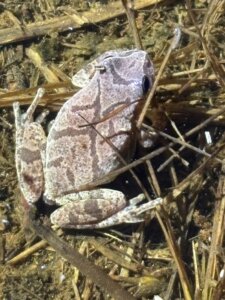
The next frogs to start calling in spring are only slightly larger: the wood frog and chorus frog. Wood frogs are closely associated with vernal pools and sound a lot like ducks quacking. Chorus frogs are found in a wide variety of wet habitats. Their song is compared to running a thumb over a comb!
By June, you can hear the high-pitched trills of American toads, and a walk in the woods on a humid or rainy day may provide an opportunity to hear the sheep-like bleats of gray tree frogs calling from their secret hiding places in tree trunks and under bark. Check out all the links in the resources below to hear sound clips of Michigan frogs and toads calling! Some of the sites even allow you to listen to a mixed chorus of frogs and help you pick out the individual species. Learning to identify frogs and toads by sound can be a great way to better understand the wildlife in your Metroparks and on your own property, as many of these are hard to see because of their size and camouflage. They also may stop calling if you get too close, making them difficult to find.
Your Metroparks are full of great places to listen for frogs and toads. Check out the trails near Stony Creek Nature Center (especially Landscape Trail to the vernal pools), Oakwoods Nature Center trails (choose the options that head into the woods vs along the river), and Indian Springs. Trails that get you away from moving water, like rivers and permanent bodies of water such as lakes, are more likely to have frogs and toads calling in the spring.
Birds of early spring
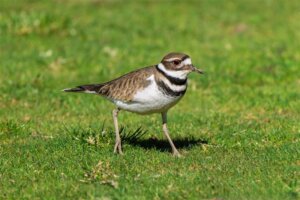
One of the ways to connect to seasonal changes and local wildlife is to learn the songs of a few of Michigan’s common backyard birds. This may seem daunting, but there are some great tools that anyone can use to help hear and identify local bird sounds- and even those of us with hearing loss can take advantage of simple technology to know what is singing at any given time!
The Merlin Bird ID app, a free app from Cornell Lab of Ornithology, is a wonderful tool for birders to use. The app can use your phone or tablet’s camera to take pictures and help you identify birds, but where it really shines is in utilizing the microphone to ‘listen’ for bird songs and identify them! It ignores most non-bird songs, and the user can set it for the region where they’re birding. This means it is a great tool for local birding adventures, but also for travel to places where you are less familiar with the bird songs and calls.
Here’s what it looks like:
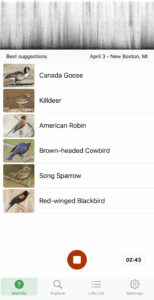 In this screenshot from a quick walk at Willow Metropark on April 3, the microphone picked up and identified six species. Each time one of the birds calls or sings, that bird will be highlighted in yellow to help users key out individual species. It also provides the spectrogram (gray chart at the top of the image) or a visual of the sound. That can help users learn the patterns of the songs.
It isn’t a perfect solution, as the bird needs to call more than once and be loud enough, which means it often needs to be fairly close to the phone or tablet. But it is a great start or support for learning, identifying, and enjoying the birds!
Upcoming programs and events to celebrate the sounds of spring:
Frog FunFest at Stony Creek Metropark – April 26th – noon- 3 -Free!
Spring Frog Fun at Lake Erie Marsh Museum- May 3rd– 2 p.m.- 4 p.m. – $3/$5 child/adult
Watching Warblers Walk– Oakwoods Metropark Nature Center – May 9th – 8 a.m.- 10 a.m. $5/18+
Birding at Lake St Clair Metropark (multiple dates) – Lake St Clair Nature Center – $5/16+
Resources for learning:
Who’s Your Froggy? Frog calls of the frogs of Michigan
Northwoods Frog Call Phenology
 YOUR ACCOUNT