
 Your Account
 Email Sign-Up
 Buy Annual Pass

World Bee Day: Buzzing with Excitement
5.20.26
By Erin Parker, Interpretive Services Supervisors
Bees give us a lot to buzz about, from pollinating some of our favorite foods to the occasional sting when we interrupt their plans. But most of the time, when we’re thinking about bees, we think about the agricultural animal that lives in human-managed hives and pollinates crops like apples and cherries. These are also the bees that produce honey and honeycomb, which both larval (baby) bees and humans like to eat.
World Bee Day, celebrated annually on May 20, seeks to raise awareness of the importance of bees and help encourage people to appreciate, rather than fear, bees.
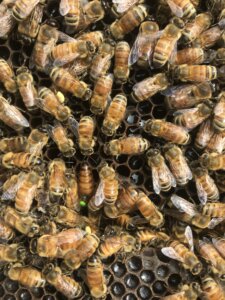
Celebrating bees starts with understanding what, exactly, makes a bee unique from other insects. World Bee Day, though, gives us an opportunity to celebrate the vast group of insects that we call bees in all their shapes, sizes, colors, and habits. These bees need protection and care, and are beautiful and interesting, too.
Bees vs everyone
Celebrating bees starts with understanding what, exactly, makes a bee unique from other insects. All bees are technically wasps, or at least the group of insects we call bees descended from the same line of insects that we call wasps. And even insect experts, called entomologists, have a hard time distinguishing some of them. This whole group has 2 pairs of wings, which distinguishes them from the flies that only have 1 pair. But flies, bees, and wasps all utilize similar coloring: that familiar black, white, and yellow that suggests keeping your distance!
Celebrating bees starts with understanding what, exactly, makes a bee unique from other insects. Most bees are vegetarian pollen-collectors covered with fuzzy hair that helps them in their mission to collect pollen. Most adult bees sip nectar from flowers and feed pollen to their larvae. Bees tend to have rounded bodies, like the bumblebees. Some bees look a lot like the smoother, more commonly hairless wasps. These bees may still collect pollen, but they store it in an internal structure called a crop. Of the species of bees that sting, they can only sting once, as their barbed stinger remains stuck in the target and rips off the bee’s own body.
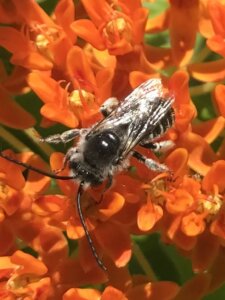
Wasps are omnivorous, so while they do eat nectar and pollen, they also consume meat, sugary foods, and even hunt spiders and insects. Wasps are typically smoother and lack the pollen-collecting hairs, and they have long legs and often have a narrow “waist”. They are generally capable of stinging more than one time, though few wasp species are actually aggressive- the problem being that we’re all really well acquainted with yellow jackets and bald-faced hornets because they’re extra territorial and don’t mind making their homes right near human activities.
Bees and wasps can be solitary or colonial. We may be more used to the colonial nests of honey bees, paper wasps, and bald-faced hornets, but many solitary bees and wasps make tiny holes in soft soil or utilize rotting trees, logs, or plant stalks for egg-laying.
Ecological importance
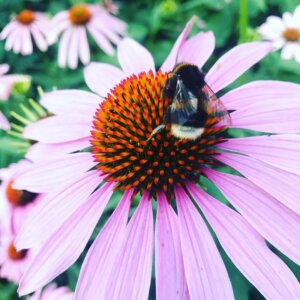
There are more than 4,000 species of bees indigenous to North America, and they are important for ecological food chains in several ways. They are key pollinators for plants as they move pollen from flower to flower, exchanging plant DNA while they search for nectar to eat. But bees (and wasps) are important food sources for a variety of birds, amphibians, reptiles, mammals, and fish. Parasitic wasps also reduce insect pests by laying their eggs directly on the larval stages of many caterpillars, where their young hatch out and consume the caterpillar feast.
Observing and supporting bees
Looking for bees is as simple as looking for the brightly colored flowers they utilize for food. Stand still and watch how often individual flowers are visited by a variety of bees, wasps, and flies. Can you tell the difference between them?
In our own yards and green spaces, increasing the flower diversity and having something in bloom from early spring to late fall can support bee diversity (along with other pollinators). Reducing or eliminating pesticide use keeps bees healthy. Providing some soft, loose soil areas where solitary bees can dig their tiny nests is important, and having damp soil or a small watering area can attract pollinators.
World Bee Day may be celebrated each year on May 20, but bees are important and worthy of celebration every day!
Resources:
Identifying Bees and Wasps (Great Lakes Region)
 YOUR ACCOUNT