
 Your Account
 Email Sign-Up
 Buy Annual Pass

Reviewing and Reflecting on the 2025 Climate Action Plan
December 10, 2025
By: Jill Martin, Interpretive Services Supervisor,
2025 Climate Action Plan Education and Engagement Year in Review
As the second full year of the Metroparks Climate Action Plan draws to a close, I’d like to share some of the progress made in the area of Education and Engagement, the first of five goals in Metroparks Climate Action Plan.
Here’s the goal:
Goal 1: Education and Engagement: Increase and embed climate action education across all areas of the Metroparks through sharing of knowledge, engaging with others, collaborating with partners, and forming connections with stakeholders, to make real world difference across the Metroparks and throughout our region.
Here’s what the Metroparks have been doing in 2025 to achieve it:
Lots of Metroparks Training Opportunities:
Six online “Lunch and Learn” presentations were made available to all staff on topics including Natural Shoreline Restoration, Climate Action and Eco Art, the Metroparks Keep It Clean Campaign, Composting, Electric and Hybrid Vehicles and Equipment, Precipitation, and Run-off and Erosion.
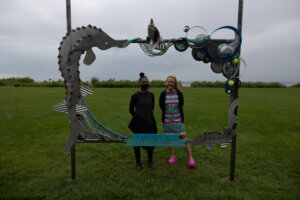
March’s Lunch and Learn presentation, led by Sidewalk Detroit Artist in Residence, Halima Afi Cassells, inspired staff at Lake St. Clair Metropark to collaborate and create an eco-art installation under her direction, with help from the community, unveiled in August. Details are profiled in a previous Metroparks Blog entry: Metroparks unveils eco photo installation
New staff are learning about the Metroparks Climate Action Plan through slides in a toolkit that was made available for all managers to share during onboarding activities.
Training through the National Network for Ocean and Climate Change Interpretation, focused on the needs of the Interpretive, Marketing, and Natural Resources departments took place in January and March. Staff learned how they could better communicate with the public, partners, and internally about climate change and the impacts the changing climate has on park resources, visitor experiences, and recreational activities.
Education on protecting our water resources was the focus for 360 employees who participated in online Stormwater Management Training this year. Every employee is required to complete this training every two years. This helps all staff understand how stormwater impacts our park resources and regional waterways.
Additionally, 153 other optional training opportunities related to climate action were documented by staff.
Blogs and Storytelling
To share stories and timely information on regional climate topics with the broader community, we have created an Environment and Climate Blog and post about current environmental topics on Facebook and Instagram. We continue to seek out new topics and collaborators, so if there’s something you’d like to share or hear about, let us know!
Public Programs
Concepts of climate change are being incorporated into existing and new programs in many ways. You can find all our climate related outreach programs in one place on The Climate Classroom , launched earlier this year. Some program highlights include:
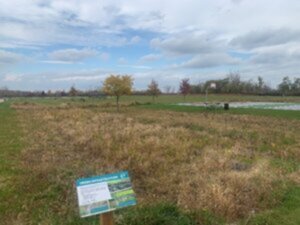
Rain Garden programs have been offered online and in Wayne County communities, in collaboration with several partner organizations.
A grant from the National Oceanic and Atmospheric Administration (NOAA) provided support for teachers and students to conduct activities that focused on water quality took place during several field trips in the 2024-25 school year. Students from Mt Clemens Middle School learned about watersheds, conducted water and air quality testing, explored their waterways, and created posters showcasing their learning for an end-of-the-school year Science Symposium celebration!
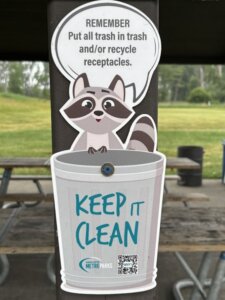
The Metroparks Keep it Clean Campaign has been sharing ways you can keep a healthy park environment front and center. Check it out before your next visit!
Chronolog photo stations that document change over time have been installed at Stony Creek, Lake St. Clair, Dexter Huron, Willow and Oakwoods. Photos are viewable at chronology.io/map. Search “Huron-Clinton” for a clickable map to find the locations and their photos. If you see a chronology station while at the park, take a photo to be included in the collection!
Professional Development Opportunities for Educators
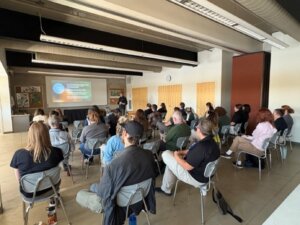
Our first Regional Informal Educator Climate Action Workshop took place in September at the Environmental Discover Center at Indian Springs Metropark, in collaboration with the Michigan Alliance for Environmental and Outdoor Education, with sixty registered attendees. Guest speakers from the Michigan DNR, Sidewalk Detroit, Michigan Department of Health & Human Services, Cranbrook Institute of Sciences, The Detroit Zoo along with Metroparks employees led several concurrent sessions on wide-ranging topics including “Public Health and Climate Change in Michigan”, “Engaging Weather and Climate Change for 6th through 8th Graders” and “Contemplative Pathways to Climate Action and Justice”.
In addition, The Winter Interpreters Workshop was held at the Environmental Discovery Center for the third time, in January, with a theme of: “Preservation and perseverance: finding and sparking inspiration in a changing time. Seventy-six participants enjoyed advice and story-sharing from peers on staying relevant during changing climates. The next Winter Interpreters Workshop will take place on January 16, 2026. More information will be available on the Metroparks Event Calendar.
More to come in 2026!
Next year we will continue our work to accomplish all five of the Metroparks Climate Action Plan goals. We hope you’ll check our blog periodically to see updates from all of the Climate Action Plan Subcommittees and find out how you can be involved and make a positive impact.
 YOUR ACCOUNT