
 Your Account
 Email Sign-Up
 Buy Annual Pass

Parks in Partnership: Michigan Vernal Pool Partnership
3.25.2026
By Kim Sherwin, Park Interpreter
As the snow melts and the rainwater pelts the ground, you may notice low lying areas in the forest begin to puddle. At first, it’s quiet, but in a short while, these areas become deafening with the calls of frogs. Later that summer, the water is gone and it’s silent again. These are possibly vernal pools.
Defining Vernal Pools
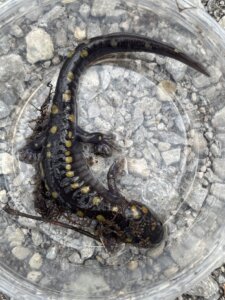
Vernal pools are not fully understood. Their existence can be short, their characteristics are extremely variable, and the amount of life they support is enormous. Though vernal pools support diverse life, and provide crucial breeding habitat for some amphibians, they are not well protected by laws and regulations. Vernal pools are small, isolated, and temporary pools that do not check all the criteria boxes for state and federal wetland protections. Without these pools, animals like spotted salamanders, wood frogs, and fairy shrimp may not survive. So, what can be done?

Monitoring Vernal Pools
Michigan Natural Features Inventory (MNFI), a program of Michigan State University extension, launched the Michigan Vernal Pool Patrol program in 2012 to identify, map, and monitor these unique ecosystems. Their goal is to better understand vernal pools through partnerships, education, and to get you, the public, involved in this community science. At Stony Creek Metropark, we are lucky enough to partner with MNFI’s Michigan Vernal Pool Patrol to help volunteers monitor the pools located within this 4,435-acre park. In spring, programming through the nature center can get you out to experience the abundant life found in vernal pools, understand their importance to wildlife and humans, and possibly, inspire you to take action to help monitor, learn, and protect them.
Volunteer your time
Official Michigan Vernal Pool Patrol volunteers take three, 2-hour virtual training sessions through MNFI and one field training to learn how to safely monitor vernal pools and record their data. If you are interested and would like to learn more, you can visit MNFI’s Michigan Vernal Pool Patrol website, https://vernal-pool-patrol-mnfi.hub.arcgis.com/. When you are ready to get your boots on and get in the field, you can contact Stony Creek Metropark Nature Center and staff can help you begin your volunteering journey in vernal pool monitoring. Stony Creek Metropark is only one park of thirteen that are a part of the nearly 25,000 acres of the Huron-Clinton Metroparks. Stony Creek Metropark Nature Center has a small group of volunteers that monitor vernal pools within Stony Creek Metropark, but we would love to grow our Vernal Pool Patrol volunteers to put them in touch with other parks within the Huron-Clinton Metroparks. Become a member of the MNFI Michigan Vernal Pool Patrol community and add to the knowledge and conservation of this small, unique, and crucial ecosystem.
Resources:
 YOUR ACCOUNT