
 Your Account
 Email Sign-Up
 Buy Annual Pass

The Birds of Winter
December 17, 2025
By: Paul Cypher, Park Interpreter
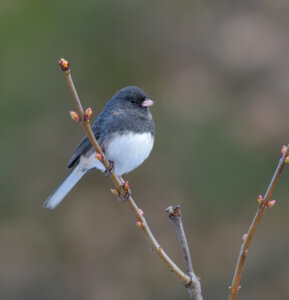
I remember fondly one of my first encounters with flocking winter birds. While I don’t remember the year (perhaps 1991 or 1992?), I remember that a small group had settled into the hawthorn in the front yard of my parent’s house in Trenton. I was thumbing through my brand-new Peterson Field Guide to Eastern Birds trying to put a name to the small bird that was gray on top and white below.
Watching them actively feed on the fruits of the tree and on fallen fruit below, I figured out that they were Dark-eyed juncos.
Little did I know that I was about the embark on the journey of a lifetime – birding. I’m not bragging, but I’ve been around. I’ve been to 49 of the 50 states and half of Canada. Bigger international travel? Maybe someday.
But for sure, there is a place in my birding heart set aside for juncos and the other winter visitors.
In the winter, when many birds have followed the insects and other non-seed foods south, there are fewer birds in the woods and in our backyards. Those that we see are a mix of residents, or birds that stick to southeast Michigan year-round, and winter visitors, birds that fly ‘south’ from the far north to spend their winters here.
Those Dark-eyed Juncos, for example, only visit Metro Detroit half of the year – basically October into May. They do breed in the northern part of the state, but head south for the winter season. So, for us Michiganders, we can have our cake and eat it too. With effort, you can see them all year round, but “down here”, we certainly think of them as a winter bird.
If you want them in your yard (and who wouldn’t), you have some good options. Set up a bird feeding station (more on that later) or let your yard get a bit wild. Native landscaping that produces seeds or berries (like my mom’s hawthorn) are a win. Brush piles are cool, too, because they can retreat there for safety or nighttime cover.
You can also visit any of the Huron-Clinton Metroparks. They are sure to have them! And you can easily watch and enjoy these winter visitors from the warmth of the interpretive centers as the birds gather at the feeding stations outdoors.
Consider also that, here in Michigan, we have it easy because there in only one species of junco – the Dark-eyed. If some ornithologists (the fancy name for “bird scientist”) had their way, there would 14 or 15 different species! If it is about 6 inches long, gray and white with a pink bill and white outer tail feathers, you’ve got it. It is one of the most common birds on the continent. If your yard is right, you’ll get them soon enough!
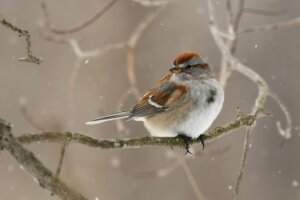
Another winter visitor to be aware of in your neighborhood is the American Tree Sparrow.
To be perfectly clear – it is a sparrow that lives in North America and has absolutely nothing to do with trees. “But it has tree in the name!” you say. Yeah, I know. I didn’t name it.
Apparently, European settlers thought it looked like their Eurasian Tree Sparrows from home so the name carried over. But the biology doesn’t. They feed on the ground, nest on the ground, and breed in northern parts of Canada and Alaska where…wait for it…there are no trees. Okay, they can also nest in scrubby areas way to the north, but “scrub” is not “forest”.
They’ll visit feeder stations, too. If such a thing is not available, they can easily make a go of it in snow-covered fields that have a lot of wildflower seed heads. Their tiny size, rusty caps and the dark spot on their chest make them stand out in a crowd.
Seeds and suet
It is worth mentioning that a winter bird feeding operation in your yard works even better when you buy quality bird food. Big box stores may sell bird seed but most of what you are buying is the junky stuff the birds won’t eat. They’ll kick it to the ground where other hungry visitors like mice dig in. So, if you are averse to feeding birds because you don’t want to grow the rodent population, do yourself a favor and buy good bird food in the first place.
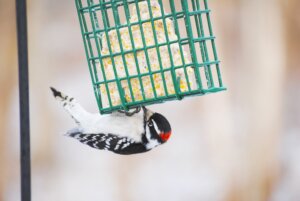
To reduce seed waste by birds simply throwing out the types they don’t want, purchase things like sunflower or safflower seeds without any of the seed mix. If you also want things like finches, try a second feeder designed to hold the tiny seeds sold as “thistle” or “niger”. Another simple feeder with virtually no mess but high value to the birds is suet. Buy it in blocks and put it out in the small metal cages designed for them. Suet attracts everything from woodpeckers to chickadees and provides an important source of fat in the winter.
One could argue that “winter birding” might be some of the best birding. Blizzards. Frigid temps. Balmy Januarys. Pour yourself that extra cup of hot cocoa or coffee and watch from the kitchen table.
That’s what helped me get started decades ago!
 YOUR ACCOUNT