
 Your Account
 Email Sign-Up
 Buy Annual Pass

Maple Sugaring Season: Changes Through Time
2.18.2026
By Erin Parker, Interpretive Services Supervisor and Steve Dishman, Park Interpreter
Living in Michigan means experiencing all four seasons from summer’s humidity to winter’s ice and snow. These conditions are perfect for the plants and trees that are indigenous to our region. Many of them even require a period of cold to trigger their growth or blooming in the spring and either don’t survive or don’t thrive in warmer climates that lack a cold winter.
Maple trees are one of these four-season-adapted plants that play an important role in our forest ecosystems and in our cultural and economic traditions. Maples have relatively shallow root systems, spreading out horizontally at or near the surface of the soil. Traditional Michigan winters prevent these roots from drying out and severe freezing, by covering them with a deep layer of snow. Younger trees with thinner bark are also protected by deeper snow. In the spring, all that melting snow helps provide water for maples as they leaf out and start their growth processes for the year.
The trend towards warmer winters with less snow (2025-2026 being an exception to this trend!) can cause damage to maple trees because when a deep-freeze does hit, the lack of insulation from the snow causes root damage and death, which then impacts the growth of trees.
Science of syruping
One of our more common maples in the Great Lakes is also an important tree for humans: culturally, historically, and economically. Sugar maple (Acer saccharum) are the tree most well-known for producing sweet sap, though other maples (and even other species of tree) can be tapped for sap to make syrup.
Maple sap is the fluid inside the tree that moves water and nutrients from the roots to the buds, branches, and leaves and then moves sugars and nutrients produced through photosynthesis back down to the roots. Sugar maple sap has a higher concentration of sugar (anywhere form 2-3%) than nearly all other trees. Even though sugar maples have the highest concentration of sugar in their sap, it still requires a great deal of boiling to evaporate out the water and leave the concentrated syrup (or sugar, depending on the product being produced!) behind. In fact, syrup producers working with sugar maples need 40 gallons of sap to boil down into one gallon of syrup.
The sap is collected only during specific seasonal conditions: the daytime temperatures must be above freezing to move the sap up from the roots and then the nighttime temperatures must be below freezing to move it back down again. Once the temperatures remain consistently above freezing, the trees bud out and the sap contains new chemical components that make it both cloudy and sour-tasting.
Maple-Making Traditions
Maple sugaring has a long history in the Great Lakes. Traditionally gathered in bark baskets and boiled using hot rocks, maple sugar was known as food, medicine, and valuable trade item. Maple sugar is easier to store, transport, and trade than liquid syrup and evidence of maple sugar has been found in artifacts even from the southeast.
Maple sugaring season has cultural and community importance as the process of collecting, boiling down, and storing the end result requires time, energy, and many hands. Modern methods of collection include plastic bags and tubes connecting multiple trees together to bring the liquid sap to one centralized location. But even with the use of metal evaporating pans instead of bark containers, time and patience are still the key ingredients to boiling off the water and concentrating the sugars!
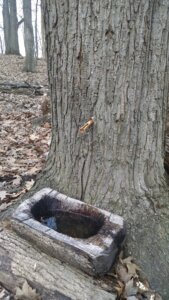
The Effects of Climate Change on Maple Syrup
Unseasonably warm weather can be potentially catastrophic for maple syrup producers. Under normal winter conditions, sap is stored frozen in the roots of a maple tree, where it gets nutrients from the soil. If temperatures rise above freezing, sap begins flowing to the branches. If temperatures remain above freezing, or rise too high, trees will begin forming buds and leaves and use the sugar-rich sap to do so.
Traditionally, late winter conditions right for maple syruping begin in February or early March, and last a couple of weeks if conditions are good. But with winters in the Great Lakes having periods of warmer weather earlier and earlier in the year, the impact can be a shortened season and/or an inferior product. Long-term consequences of climate change could mean fewer areas where maple syrup can be produced, or even fewer suitable trees to harvest from- sugar maples only thrive in regions with four-season climates and plenty of rainfall.
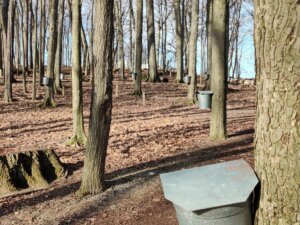
Responsible maple syrup producers, upon choosing trees, make sure to drill holes in different spots each year, or even stop tapping certain trees to allow the tree to heal from the holes and continue in its normal growth. With fewer trees and regions to harvest from, maple syrup products might become scarcer to find and costs will rise. Maple syrup producers are always looking for ways to fight the effects of climate change. Over the years, sap collection has improved in its reliability and producers are able to diversify the maples used for maple syrup.
If you’re interested in more about maple syrup production at your Metroparks, visit us throughout the month of March at Hudson Mills, Kensington, Oakwoods, and Wolcott Mill Metroparks.
 YOUR ACCOUNT