
 Your Account
 Email Sign-Up
 Buy Annual Pass

Life Under the Snow
1.14.2026
By: Steve Dishman, Interpreter
A blanket of white snow covers the landscape. It’s a lovely winter wonderland. But did you know there’s a whole different world under the snow? Here are some remarkable animals and their adaptations that help them thrive during the frigid winter months.
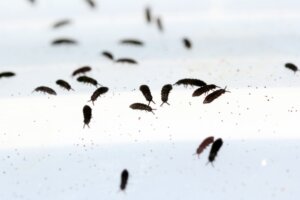
One of the smallest animals under the snow, Hypogastrura nivicola or commonly called the snow flea, is a type of springtail. These are one of the few invertebrates that can be active throughout the winter!
These remarkable invertebrates are a mere 1/16 of an inch long. On warmer winter days, snow fleas clump in large groups on top of the snow but when temperatures drop, they have a special protection. Snow fleas have a special protein in their bodies that acts a bit like antifreeze in a car. This protein helps to keep the water around them from freezing even in subzero weather. This special protein keeps the food that snow fleas enjoy, usually plants like algae and moss or fungi, fresh so they can consume it all winter long. So, if you venture out into your yard on a warm winter’s day, look closely for these remarkable, harmless springtails. They can often be found at the base of tree as tiny, wiggly dark speckles on top of the snow!
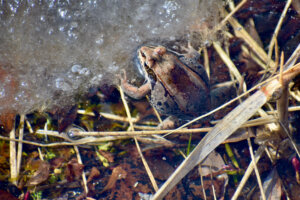
Larger animals also have special snow adaptations. The Wood Frog, (Lithobates sylvaticus), survives the winter by freezing itself. In autumn, wood frogs bury themselves under leaves and begin to produce high amounts of glucose and urine. When the temperatures drop, wood frogs use glucose and urine to protect their organs from freezing with the oncoming ice. Other Michigan frogs hibernate in the water under the ice, but wood frogs will become frozen on land. But when spring arrives, the ice melts around the wood frogs and they can leave hibernation almost immediately.
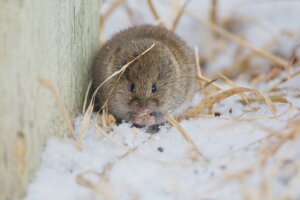
A final example of an animal living under the snow is the Eastern Meadow Vole, Microtus pennsylvanicus, commonly seen across Southeastern Michigan. Sometimes called a meadow mouse, meadow voles are active all year long. When the snow comes, meadow voles will dig pathways through and under the snow cover, allowing travel to their nests as well as their favorite feeding grounds. In the winter, meadow voles will eat all kinds of plant matter, including roots, bark, seeds, and bulbs. The snowy pathways of meadow voles also provide cover especially when raptors like hawks and owls are on the prowl.
So, on the next snowy day as you venture about, look at a snowbank. Who knows? Maybe you’ll find a colony of snow fleas or the pathways of a hungry meadow vole. Happy Winter!
 YOUR ACCOUNT