
 Your Account
 Email Sign-Up
 Buy Annual Pass

12 Months of Metroparks: January
January 1, 2026
By: Erin Parker, Interpretive Services Supervisor
Happy New Year! Here’s to kicking off new adventures and exploring your Metroparks. The coldest months of year still provide many opportunities to observe wildlife and natural phenomena in the Parks. Our 12 Months of the Metroparks blog series will be showcasing some of the specific wildlife to seek out during each month and even some specific parks to visit. So bundle up and let’s get outside.
Raptor watching
January may seem like a quiet month on the wildlife front, but for many animals, it’s actually the start of their mating and breeding seasons and they’re actively courting, breeding, and even setting up their nests. Raptors, the group of birds that includes hawks, owls, and eagles, are just one example.
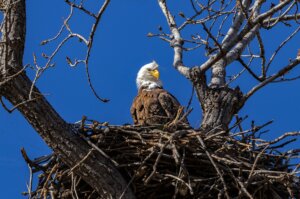
Bald eagles and great-horned owls are among the first to lay eggs and start sitting on their nests in the earliest months of the year. It takes about 5 weeks for an eagle egg to incubate. Both parents take turns sitting on any eggs (typically 1-3 are laid) although the female eagle does the majority of the time sitting on the nest. From hatching (or pipping, when the eaglet breaks open the eggshell) they will spend another several months being fed by their parents, growing and learning to fly. Eaglets will leave the nest 3-4 months after hatching. Great-horned owls follow similar a similar pattern. The biggest difference between the 2 species is their nests: eagles will construct huge nests of sticks while owls don’t really do any nestbuilding of their own, preferring to use old squirrel or bird nests or even buckets, baskets, or other human-provided nests.
Imagine the weather that they experience while the eggs and young are at their most vulnerable? Eagles and owls will incubate through snow, rain, sleet, hail, and the deep cold temperatures that we experience here in Michigan in the winter.
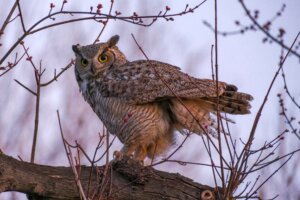
This is one of the many reasons that we utilize trail closures and expect visitors to follow good etiquette and ethics. Any behaviors that cause the adults to change their behavior, especially flying off the nest, can cause nest failure or harm to the eggs and young that must be kept warm at all times.
Where can you observe eagles and owls in the winter? Lake St Clair Metropark has an active, second-year eagle nest visible from the hike-bike path near the park entrance and a great-horned owl nesting bucket that traditionally hosts great-horned owls. Stony Creek Metropark has an active eagle nest, best viewed with a spotting scope, from the Inwood Trails. Check out staff-led programs, too, that include using spotting scopes and information about how to best view, photograph, and safely observe nesting eagles and owls at metroparks.com.
Songbird sounds
Another wonderful winter wildlife experience that begins in January is the songs of some of our resident birds, such as northern cardinals and black-capped chickadees. Residents are those birds that spend their year here in southeast Michigan rather than heading south for the winter. While the woods can feel fairly quiet in late fall, as songbirds are much less likely to sing during this period, the resident birds will begin their songs in mid-to-late January as spring approaches on the horizon. They frequently begin to nest earlier than migratory songbirds and the slow return of daylight after the solstice starts to trigger their songs again.
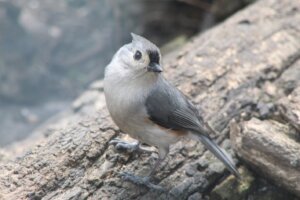
Learning your resident birds in the winter can be a great gateway into birding, there are fewer species to observe and it can be easy to watch them from indoors on inclement days. Or take a walk in the woods and listen for their calls. They are often moving around in mixed species flocks, seeking seeds and shelter, and you may hear and observe several types of birds in one small group.
Check out the feeder stations (and programming to help you learn to identify birds by sight and song) at Kensington, Stony Creek, Lake Erie, and Oakwoods Nature Centers.
Tracks in the snow
If you’re seeking out non-bird wildlife, winter can provide the perfect landscape for observing tracks and other sign of animals. A light dusting of snow can make the perfect canvas for footprints. Especially with nocturnal animals, active after dark, the winter months can be a great time to see ‘who’ is using the Metroparks or your own backyard. Tracks and sign can be observed in any Metropark, just keep an eye out for good weather- a light dusting of fresh snow the evening previous to your adventure can be the perfect opportunity for discovering the many wild residents that call our region home!
 YOUR ACCOUNT