
 Your Account
 Email Sign-Up
 Buy Annual Pass

12 Months of the Metroparks: February
2.11.26
By Erin Parker, Interpretive Services Supervisor
Despite the deep cold and snow that have carried over from January in 2026, February is truly a month of transitions. The natural world may appear to be locked into winter, but careful observation shows that things are changing and spring is around the corner.
Overwintering insects
First, this is still a great time for quiet observation of the smaller clues left behind by wildlife. The leafless trees and snow provide a perfect backdrop to spot a variety of insects egg cases, cocoons, and more. Some of these insects are considered pests while others a critical part of our ecosystems.
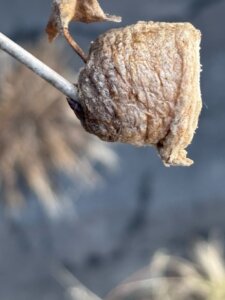
Look in unmowed fields and natural areas for the egg cases (called oothecae) of praying mantids. The hard foamy looking cases are laid in late summer and contain anywhere from 50-200 eggs. In early spring, these eggs will all hatch simultaneously, with the tiny mantids seeming to explode outward from their winter case and hopping away from each other, as they are insect predators and will consume one another as a first meal! These cases are from a nonindigenous mantid species, introduced from Asia both unintentionally and then later on purpose to reduce garden pests. However, they may consume enough indigenous insects and pollinators that they are more destructive than beneficial to wild invertebrate populations. At home and in your garden, feel free to pull the cases and add them to a bird feeding area or add them to a bucket of soapy water to reduce them.
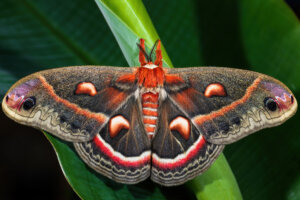
A more challenging series of overwintering insects are the cocoons of Michigan’s giant silkworm moths. Cocoons, often made of plant material and silk from the caterpillars, disguise and protect the overwintering pupae. In the early spring, the hard pupa case inside the outer leafy cover will break open as the adult moth emerges. These insects typically live only a few days as adults, and most of them do not even feed. They simply search for a mate, and if successful, lay the eggs that become the next generation of moths!
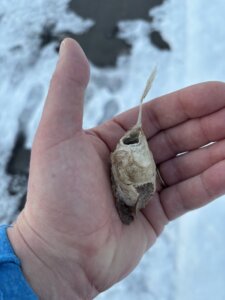
Cocoons, like this one from our largest silkworm moth, the Cecropia moth, can be found hanging from a twig or branch but will more likely be found attached with silk threads to a wood pile or shed, tree trunk or other object that provides more protection from predators and the elements!
Cecropia, promethea, luna, and other large silkworm moth cocoons can be spotted in the winter though most are down in the leaf litter, protected by leaves and a layer of snow.
Plant power
Two other important, if quiet, events start to take place in February.
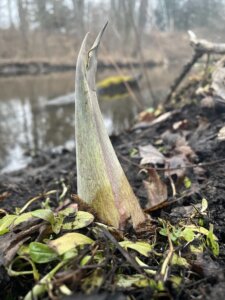
If you are exploring the Metroparks’ many wetland areas, you are likely to spot a strange-looking plant not just poking up from the snow…but actually melting the snow around it. By February, the first skunk cabbage of the year should be visible in the rich soil around many of our local wetland areas.
These unique plants are thermogenic, or capable of creating enough warmth to melt their way through the deep freeze of a typical February. Their purplish-red flower structure, the first part of the plant to emerge, is attractive to the earliest spring insects including the flies that pollinate the pungent plant. Later, huge neon green leaves will appear and remain all summer. The plant gets its name for its sulphury skunk smell combined with the giant cabbage-y leaves.
Finally, February often ushers in the start of maple syrup season as the temperatures start to fluctuate. Maple sap starts flowing when winter days are above freezing and maple syrup conditions require the flow during the day and the cold nights that keep the trees from actually bursting their buds and leafing out, which changes the makeup of the sap and ends the season. Warmer winters over the last few years have altered the timing of maple sugar season as it is driven by the weather conditions during the day and the night. The period of time of good sap production requires both the warm daytime temperatures and the cold nighttime temps. Keep an eye out for dripping sap from any winter tree injuries as you’re exploring this month- and an eye on the calendar for the many programs and events throughout the Metroparks that let you enjoy the season’s syrup!
 YOUR ACCOUNT