
 Your Account
 Email Sign-Up
 Buy Annual Pass

Recording Landscape Changes through Time
December 21, 2025
By: Erin Parker, Interpretive Services Supervisor
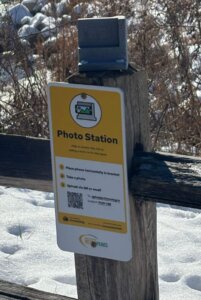
Floods, prescribed burns, tree plantings, meadow installations. The stories of our landscapes are told through change. Changes through time can occur rapidly, such as a prescribed burn in a field that reduces encroaching trees and helps non-indigenous plants from spreading. But changes can also be slow, such as the conversion of turf grass lawn to diverse, flowering pollinator meadow.
One of the tools that we use at your Metroparks to help us track those changes are a series of photo stations, called Chronologs, that allow all park visitors and staff to capture images across the seasons and years at the same place, it the same orientation, and be uploaded to become a timelapse record of change and growth. They’re also an engaging way to explore the parks.
Seasonal fluctuations and natural phenomena
Chronolog photo stations are installed at several locations across six of the Metroparks so far. The locations were selected to capture specific projects or places within the parks.
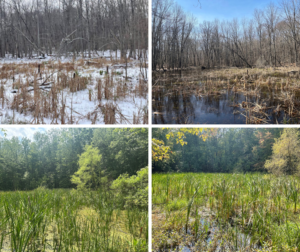
At Stony Creek Metropark, one of our active vernal pools was chosen because of the specific seasonal changes that can be observed as it naturally captures snowmelt and rain water in the spring and then slowly dries up over the summer. Snow fills it again in the winter and starts the process all over again. You can observe the seasonal changes as a timelapse here:
https://www.chronolog.io/site/HCM104
This year’s drought conditions were also captured via the timelapse from the Riley Creek overlook at Lake Erie Metropark. From a marshy creek full of water lilies to a dried mud bed, the changes in the water levels as the summer’ s dry conditions dragged into the fall and winter were all captured via simple cell phone footage for a striking video of natural changes. You can watch the drought encroach and change Riley Creek here: https://www.chronolog.io/site/HCM112
Capturing growth and change of Metroparks’ restoration projects
While many of the photo stations were installed to showcase natural change through the seasons, others were placed to capture changes after a restoration project. Prescribed fire, tree plantings, softened shorelines, creation of pollinator habitat and grow zones- all of these are projects that have been implemented in the Metroparks to protect our water, increase our habitat diversity, manage nonindigenous plants, and more. While the immediate aftermath of some of these projects can seem stark, using photography to capture a timelapse gives a better sense of the actual growth and change through time.
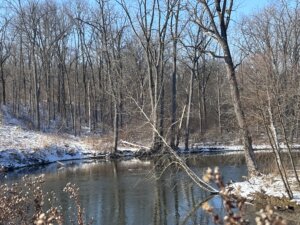
A major restoration project at Willow Metropark is showcased in a photo station at the Big Bend section of the Huron River, and easily observed from the paved hike-bike path there. The shoreline renovation reduces erosion and sediments from the river, while adding a wildlife-friendly pollinator habitat on the slope. View this restoration project here: https://www.chronolog.io/site/HCM110
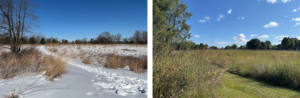
Before you head out for an adventure at your Metroparks, check out all the Chronolog stations here: https://www.chronolog.io/map and search for Huron-Clinton Metroparks. Then, add your own photos to the growing timelapse at each site. The directions for uploading are on each station and the more photos that are added, the better the picture that emerges of our Parks through time.
 YOUR ACCOUNT