
 Your Account
 Email Sign-Up
 Buy Annual Pass

Cover Crops and Soil Health
December 3, 2025
By: Jason Smith, Supervising Interpreter Farm and Historic Center
It’s everyone’s favorite time of year! World Soil Day! Celebrated annually on December 5, maybe World Soil Day doesn’t rank up there quite as high as the many other winter holidays, it does help us focus on something important: the soil.
Have you ever considered the soil? While many of us may think of soil as synonymous with dirt, they’re really not the same thing! Soil is an ecosystem created of living and nonliving things, a mixture of air, water, organic matter, and minerals. Its critical to life on the planet because it supports our plants and vegetation along with a wide variety of other organisms from fungi to bacteria to arthropods to mammals. “Dirt” typical refers to any dust or mineral that we’ve encountered in a place we don’t want it, such as tracked across the kitchen floor when we forgot to take our shoes off at the door.
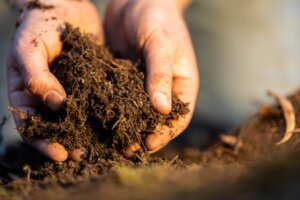
If you work on a farm or garden, you may be deeply interested in the health of your soil because it drives the health of the plants or crops grown there. One way that farmers and gardeners can preserve and protect their soil health is through the use of a cover crop.
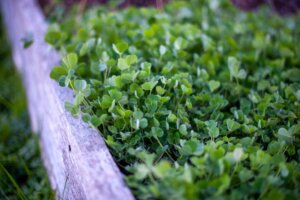
A cover crop is a general term that is used for any plant that covers the ground either in between plantings of a cash crop (i.e. soybean, wheat, corn etc), inter-seeded into that cash crop, or planted in a fallow field that is resting from crops for a period of time. Cover crops are used as a way to simply cover the ground, ideally with a plant or a mixture of plants that give nutrients back to the soil that the recent cash crop planting used and/or that the future cash crop planting will be utilizing. This helps restore nutrients and potentially organic matter back into the soil when the cover crop is tilled or cut and left to amend the soil as it breaks down.
Why are cover crops important?
Recent soil health studies have shown how destructive bare soil is to its health and longevity, so cover crops are great to implement into your rotation, whether you have a large farm or a small garden (yes! you can use them in your garden as well!). When soil is left bare and exposed, the elements can have a large negative impact on it. Heavy rains, strong winds, frigid or hot temperatures can cause the top layer of the soil to run off, blow away, dry out, or become compacted. Important microbes and fungi that give our soil “life” start to die because there is no protection for them from these harsh elements. Cover crops not only cover and protect the soil from these conditions but have been shown to improve soil health and structure[1]. Unfortunately, there is no one-size-fits-all solution, which can make it difficult to know where to start with them.
Where can I start to learn about them?
The amount of information on cover crops could make your head spin, which is why it’s important to have a management plan prior to using any sort of cover crop. This management plan can include where and when you plan to seed your cover crop and how you plan to terminate it. There are endless combinations of plants you can use in your cover crop mix. In fact, there are companies that have 15+ species of plants in one mix (a word of warning with these mixes, you probably will have only about 6 of those 15 species actually germinate and you spent the money on 15 different seeds). Cover crop seed companies are commonplace now, with salespeople convincing you that one application of their premium cover crop mix will fix all of your soil and weed problems. This simply isn’t true, and nothing can replace a soil test to tell you what you need in your soil. A helpful tool that I’ve found in my cover crop journey is the Selector Tool on the Midwest Cover Crop Council website. It is currently only for row crops, but it looks like they are working on one for vegetable growers, so stay tuned home gardeners! You can also contact your local Natural Resources Conservation Services office for help and guidance related to cover crop usage and selection.
How does the Farm Center at Wolcott Mill Metropark use cover crops?
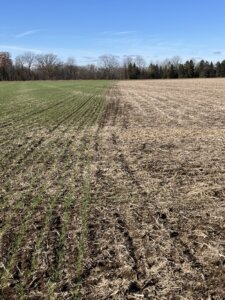
At our Farm Center at Wolcott Mill Metropark, we have implemented cover crops into our crop rotation along with no-till practices. While many visitors focus on the animals at the Farm Center, we also grow all of our own feed for our animals! Currently we farm about 125 acres of crop land, of which 85 acres is considered no-till (meaning we don’t till these acres after harvesting a crop. We leave the stubble from corn or beans to cover the ground in the winter and then plant into the remaining debris in the spring) and 35 acres are covered with a cover crop or live crop. Only about 4-5 acres are still being tilled. We have walking paths around all of our fields at the Farm Center where guests can observe and enjoy the beauty of our fields up close.
Overall, cover crops can be a worthwhile solution to improve your soil health; it will just take a bit of time and effort to make sure you know how best to use them in your own operation.
[1]https://www.sare.org/publications/cover-crops-ecosystem-services/10-ways-cover-crops-enhance-soil-health/
 YOUR ACCOUNT